
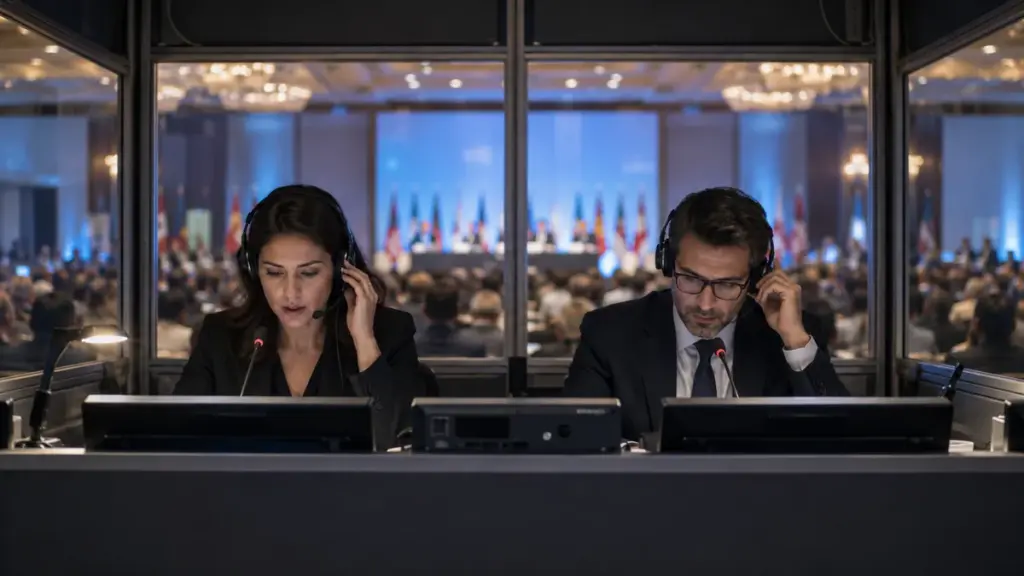
Simultaneous Interpretation Services enable multilingual audiences to follow a speaker in near real time without repeatedly stopping the presentation. The interpreter listens, analyses the message and renders it into another language while the speaker continues. This mode is widely associated with international conferences, summits, congresses, large corporate meetings and other events where maintaining the pace of the programme matters.
Translation All World coordinates interpreters, event preparation and the technical setup required for on-site, hybrid or remote sessions. Depending on the venue and audience, the arrangement may include sound-isolated booths, interpreter consoles, microphones, receivers, headsets and multiple language channels. Remote Simultaneous Interpreting, commonly shortened to RSI, can also be organised for online events. The correct setup depends on the number of languages, session length, participant count, venue acoustics and the platform used for remote attendance.
What Are Simultaneous Interpretation Services?
Simultaneous Interpretation Services are a form of spoken-language interpreting in which the interpreter conveys the speaker’s message into another language at almost the same time as it is delivered. Unlike consecutive interpreting, the speaker does not normally pause every few sentences for the interpreter. This preserves the natural rhythm of a conference, panel or presentation and avoids substantially extending the running time of the programme.
For conventional conference interpreting, interpreters usually work from a booth and listen to the floor audio through a headset. Their interpretation is transmitted to participants through dedicated language channels. Portable systems or whispered interpreting may be appropriate for smaller settings, while larger multilingual events generally require a structured audio-distribution system. The interpreter is not simply repeating words: meaning, intent, terminology, tone and context must be processed while new information is still arriving.
The service therefore begins before the microphone is switched on. Speaker notes, slide decks, agendas, names, acronyms and specialist terminology should be shared in advance whenever possible. Preparation allows the interpreting team to build terminology resources, clarify ambiguous references and understand the structure of the event. Translation All World uses this information to match the language combination and subject area with the appropriate interpreting team and technical arrangement.
Where Are Simultaneous Interpretation Services Used?
Simultaneous Interpretation Services are most suitable when a sizeable audience needs to hear a speech, presentation or discussion in another language without interrupting the speaker. International conferences and congresses are the clearest examples, but the same mode can be used for diplomatic meetings, shareholder events, product launches, training programmes, academic symposia and multilingual corporate broadcasts.
The table below compares common event formats and the interpreting setup that is typically considered. The final configuration is always based on the venue, programme and language requirements rather than the event label alone.
| Event Type | Typical Interpreting Mode | Technical Requirement |
|---|---|---|
| International conference | Simultaneous interpreting | Booth, console, headsets and language channels |
| Hybrid summit | On-site plus remote simultaneous interpreting | Booth or RSI platform with tested audio routing |
| Large training programme | Simultaneous or consecutive interpreting | Depends on audience size and interaction |
| Small bilateral meeting | Usually consecutive interpreting | Often no booth required |
| Online webinar | Remote simultaneous interpreting | Platform with interpreter channels or RSI integration |
For events with several target languages, each language channel must be planned separately. The organiser should also consider session length, breaks, speaker changes and whether recorded or streamed content will be used. A technical rehearsal is especially important when remote speakers, video playback or hybrid participation are involved, because poor source audio directly affects what the interpreter can hear and therefore what the audience receives.
What Equipment Is Needed for Simultaneous Interpreting?
A reliable simultaneous interpreting setup depends on clean source audio and controlled delivery to each language channel. In a conventional venue, interpreters may work in sound-isolated booths equipped with interpreter consoles, headsets and microphones. Participants receive the interpreted audio through receivers and headsets, while the conference sound system routes the speaker’s microphone to the interpreting team. The number of booths and channels depends on the number of target languages.
- Interpreter booths: provide an acoustically controlled workspace and allow interpreters to hear the floor audio clearly.
- Interpreter consoles: let interpreters select channels, monitor sound and activate their microphones.
- Receivers and headsets: allow participants to choose the language channel they need.
- Microphones and audio distribution: carry the speaker’s voice to both the room and the interpreting system.
- Technical monitoring: helps identify audio, channel or connectivity issues during the event.
Equipment should be selected according to the actual room and production plan. A small portable setup can be sufficient in one venue, whereas a multi-room congress may need separate booths, relay arrangements and dedicated technicians. Translation All World can coordinate the interpreting requirement with the event’s audiovisual team so that microphone routing, channel allocation and interpreter monitoring are tested before participants arrive. Technical preparation is not separate from language quality; interpreters cannot accurately render speech they cannot hear clearly.
How Do Remote Simultaneous Interpretation Services Work?
Remote Simultaneous Interpreting allows interpreters and participants to join from different locations while retaining separate language channels. The event may take place entirely online or use a hybrid format in which some speakers and attendees are physically present. Platforms such as Zoom, Microsoft Teams and dedicated RSI systems can support multilingual audio, but the available features and channel controls differ between platforms.
A remote project should be tested before the live session. The organiser needs to confirm how speakers connect, how interpreters receive the floor audio, how participants select a language and how backup communication will work if a connection fails. Headsets and stable internet connections are important for speakers and interpreters because laptop microphones, echo and background noise can reduce intelligibility.
- Confirm the programme: identify session times, languages, speakers and audience locations.
- Choose the platform: verify that the required interpreting channels and participant permissions are available.
- Share preparation material: provide slides, agendas, names and specialist terminology to the interpreters.
- Run a technical rehearsal: test microphones, audio routing, language selection and backup channels.
- Monitor the live event: coordinate interpreters, speakers and technical support throughout the session.
What Affects the Cost of Simultaneous Interpretation Services?
The cost of Simultaneous Interpretation Services is normally shaped by both linguistic and technical requirements. Interpreter time is one component, while booths, receivers, headsets, consoles, technicians, travel and remote-platform requirements may form separate parts of the quotation. A short single-language meeting therefore has a very different cost structure from a multi-day congress with several interpretation channels.
Duration is particularly important because simultaneous interpreting is cognitively demanding and longer sessions are normally planned with interpreters working as a team and alternating. The number of target languages can also increase both interpreter staffing and equipment requirements. Venue location, room count, rehearsal time, early setup, recording, streaming and hybrid production may affect the technical plan. For remote events, platform choice, technical support and the number of concurrent rooms or channels should be defined before pricing.
For an accurate quotation, organisers should provide the event date, venue or online platform, working languages, approximate participant count, session timetable and expected subject matter. If a venue already has interpreting infrastructure, this should also be stated. Translation All World can then separate the interpreting and technical components of the project and identify which services are necessary for the event rather than applying a generic package.
Frequently Asked Questions
What is the difference between simultaneous and consecutive interpreting?
In simultaneous interpreting, the interpreter renders the message while the speaker continues, so the programme can proceed with minimal interruption. In consecutive interpreting, the speaker pauses after a segment and the interpreter then delivers that segment in another language. Consecutive interpreting is often suited to smaller meetings and interactive discussions, while simultaneous interpreting is commonly used for conferences and larger multilingual audiences.
Why are two interpreters often assigned to one language channel?
Simultaneous interpreting requires continuous listening, analysis and speaking at the same time. For longer sessions, interpreters commonly work in teams and alternate so that concentration and delivery can be maintained throughout the event. The exact staffing plan depends on session duration, difficulty, breaks and event conditions. Short assignments may be assessed differently, so the final team structure should be confirmed during planning.
Can simultaneous interpreting be provided for more than one language?
Yes. Multilingual events can use several interpretation channels at the same time. Each target language requires its own interpreter planning and, in conventional conference settings, may also require a dedicated booth or channel configuration. The organiser should provide the complete list of working languages early so that interpreter availability, equipment, relay needs and participant headset requirements can be planned together.
Can you provide simultaneous interpreting for online events?
Yes. Remote simultaneous interpreting can be organised for webinars, virtual conferences and hybrid meetings when the chosen platform supports the required language-channel workflow or can be integrated with an RSI system. A technical rehearsal is recommended before the event to check speaker audio, interpreter access, participant language selection and backup communication. Good source audio and stable connectivity are essential for reliable remote interpreting.
What information is needed for a simultaneous interpreting quote?
Provide the event date, location or online platform, start and finish times, working languages, number of participants and a basic programme. It is also useful to share the subject area, number of rooms, planned breaks and whether booths, receivers, headsets or technical staff are already available. These details allow the interpreting team and equipment requirement to be calculated for the actual event.