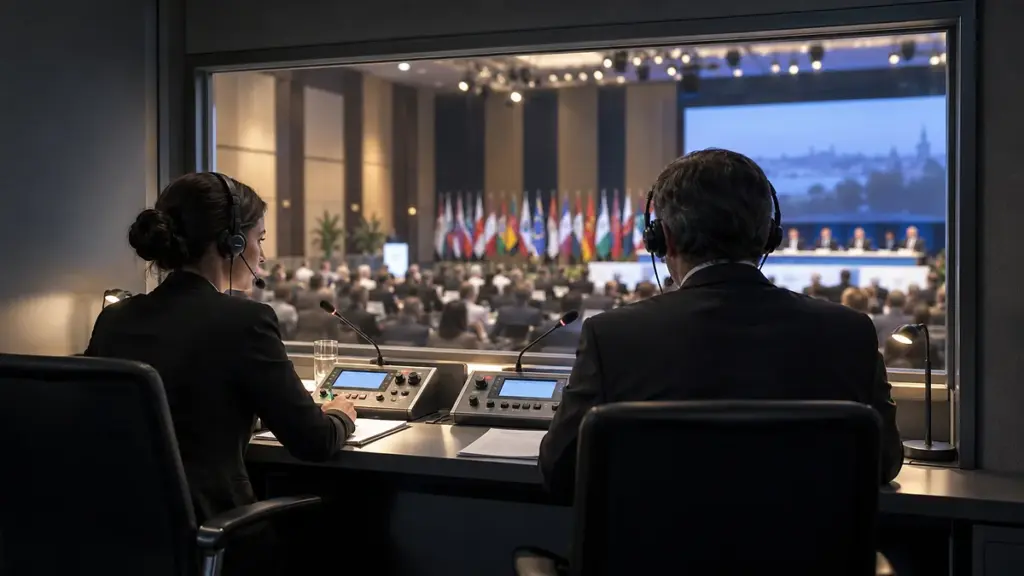
Simultaneous Interpretation Cost is built from several components: interpreter fees, the number of interpreters required for each language, event duration, preparation time, technical equipment and on-site or remote support. A conference budget should therefore not be based on a single hourly interpreter rate. Large events may require booths, receivers, headsets, microphones, sound distribution and technicians in addition to the interpreting team.
Professional simultaneous interpreting is normally staffed in teams because interpreters listen, process and speak at almost the same time. For longer sessions, interpreters rotate to maintain performance. Remote Simultaneous Interpretation, commonly called RSI, removes some travel and physical-booth costs but introduces platform, audio-routing and technical-support requirements. Translation All World prepares event-specific quotations after reviewing the language channels, programme, venue or platform, participant count and subject matter.
How Is Simultaneous Interpretation Cost Calculated?
Simultaneous Interpretation Cost is usually calculated per interpreter for a half day or full day rather than by the minute. Even a short session can require advance preparation, travel, sound checks and reserved availability. The number of language directions also matters: an event with one English–French channel is simpler than a multilingual conference that needs several booths or relay interpreting.
The interpreter’s subject expertise can change the rate. A medical congress, financial regulatory meeting or technical engineering event may require specialists who review presentations and terminology before the event. Rare language pairs can also increase costs because the available pool of experienced conference interpreters is smaller.
- Interpreter team: number of interpreters per language channel and total event hours.
- Language combination: availability, direction and whether relay is required.
- Venue or platform: on-site booth system, portable equipment, hybrid setup or RSI platform.
- Participant count: number of receivers, headsets and audio channels.
- Technical support: setup, sound check, monitoring, technician time and dismantling.
- Travel: transport, accommodation and per diem when interpreters or technicians travel.
What Is a Typical Simultaneous Interpretation Cost in 2026?
Published 2026 international guides place professional simultaneous conference interpreting above general liaison or consecutive interpreting because of the cognitive load, team structure and technical requirements. A common benchmark is approximately USD 125–250 per hour per interpreter for conference-grade work, while full-day rates are often around USD 600–1,200 or more per interpreter depending on language, market and subject specialization.
| Budget Item | Typical Model | Indicative 2026 Benchmark |
|---|---|---|
| Simultaneous interpreter | Per interpreter / hour | About USD 125–250 per hour |
| Full-day conference interpreter | Per interpreter / day | About USD 600–1,200+ per day |
| Second interpreter | Per language channel | Often required for longer assignments |
| Booth, receivers and sound equipment | Rental / event package | Venue and participant dependent |
| RSI platform and technical support | Event package / platform fee | Depends on languages, users and support level |
These are market planning figures rather than fixed tariffs. Equipment packages can vary substantially between a 30-person boardroom and a 1,000-person congress. A final Translation All World quote is therefore based on the programme, venue or online platform, language channels and number of participants.
Why Are Two Interpreters Often Needed?
Simultaneous interpreting requires continuous listening, analysis, reformulation and speech production at the same time. Maintaining this level of concentration for long uninterrupted periods increases the risk of fatigue and omissions. Professional conference practice therefore commonly uses two interpreters per active language booth for sessions that extend beyond a short duration. The interpreters alternate, while the colleague who is not speaking continues to follow the discussion and may assist with terminology, figures or names.
This staffing model affects the budget because the client is paying for a team, not a single voice in the headset. For multilingual events, each additional active language channel may require its own team. Highly complex or long programmes can require more than two interpreters per language, particularly when the schedule has overlapping sessions or very long working days.
Reducing the team below professional staffing levels can appear cheaper but may create performance and scheduling risks. Translation All World considers session length, breaks, technical format and subject complexity when determining the team size rather than applying one rule to every event.
How Does RSI Affect Simultaneous Interpretation Cost?
Remote Simultaneous Interpretation can reduce some physical-event expenses because interpreters do not necessarily need to travel to the venue and a traditional booth may not be required. However, RSI is not simply a video call. It depends on stable high-quality audio, separate interpretation channels, platform configuration, interpreter consoles or compatible interfaces and technical monitoring throughout the event.
For a fully remote event, the budget can include interpreter fees, RSI platform access, technical support, rehearsals and contingency planning. Hybrid events can be more complex because in-room microphones, remote speakers and language channels must all be routed correctly. A poor audio feed can affect interpretation regardless of interpreter experience, so technical preparation should not be removed purely to reduce cost.
RSI is particularly useful for international meetings where travel would otherwise account for a significant part of the budget. Whether it is cheaper overall depends on participant numbers, platform requirements and event duration. Translation All World can compare an on-site booth setup with an RSI or hybrid configuration before the event format is finalized.
What Information Is Needed for an Accurate Conference Quote?
A conference quote becomes accurate only when the interpreting team and technical supplier can see the event structure. The date alone is not enough. Organizers should provide a draft agenda, start and finish times, language channels, participant count, venue details and information about remote speakers. Presentation files and terminology lists are also useful for assessing subject complexity.
- Confirm the event date, city or online platform and expected working hours.
- List every source and target language required and whether sessions run simultaneously.
- Share the expected audience size and number of people who need headsets or language channels.
- Provide the agenda, presentation topics and any specialist terminology or speaker materials.
- State whether the venue already has booths, audio equipment and technicians or whether a complete technical package is required.
With this information, Translation All World can separate interpreter fees, technical equipment, platform costs, travel and support instead of presenting one unexplained total. This also allows organizers to compare on-site, remote and hybrid alternatives.
Frequently Asked Questions
Is simultaneous interpreting charged by the hour or by the day?
Both models are used, but half-day and full-day minimums are common because interpreters reserve the assignment, prepare terminology and attend technical checks. Very short sessions may still attract a minimum booking charge. The exact model depends on the market and event schedule. The event agenda, language channels and technical setup should be reviewed together because each of these can change staffing and the final conference budget.
Does every event need two simultaneous interpreters?
Not every short assignment requires the same staffing, but longer simultaneous sessions are commonly handled by teams of two interpreters per active language channel. The team size should be determined by duration, complexity, breaks and professional working conditions. The event agenda, language channels and technical setup should be reviewed together because each of these can change staffing and the final conference budget.
Is equipment included in the interpreter fee?
Usually not automatically. Booths, headsets, receivers, microphones, sound distribution and technicians are separate budget items unless the quotation explicitly bundles them. Always check whether a proposal covers interpreters only or a complete technical package. The event agenda, language channels and technical setup should be reviewed together because each of these can change staffing and the final conference budget.
Is RSI always cheaper than on-site simultaneous interpreting?
No. RSI can remove travel and some physical-equipment costs, but platform licensing, remote audio infrastructure, rehearsals and technical support remain necessary. For hybrid events, the technical setup can be more complex than a fully on-site or fully remote format. The event agenda, language channels and technical setup should be reviewed together because each of these can change staffing and the final conference budget.
Why does a rare language pair cost more?
Experienced conference interpreters are not equally available in every language combination or location. A smaller professional pool can increase travel requirements and scheduling difficulty. Highly specialized subject matter can further narrow the number of suitable interpreters. The event agenda, language channels and technical setup should be reviewed together because each of these can change staffing and the final conference budget.